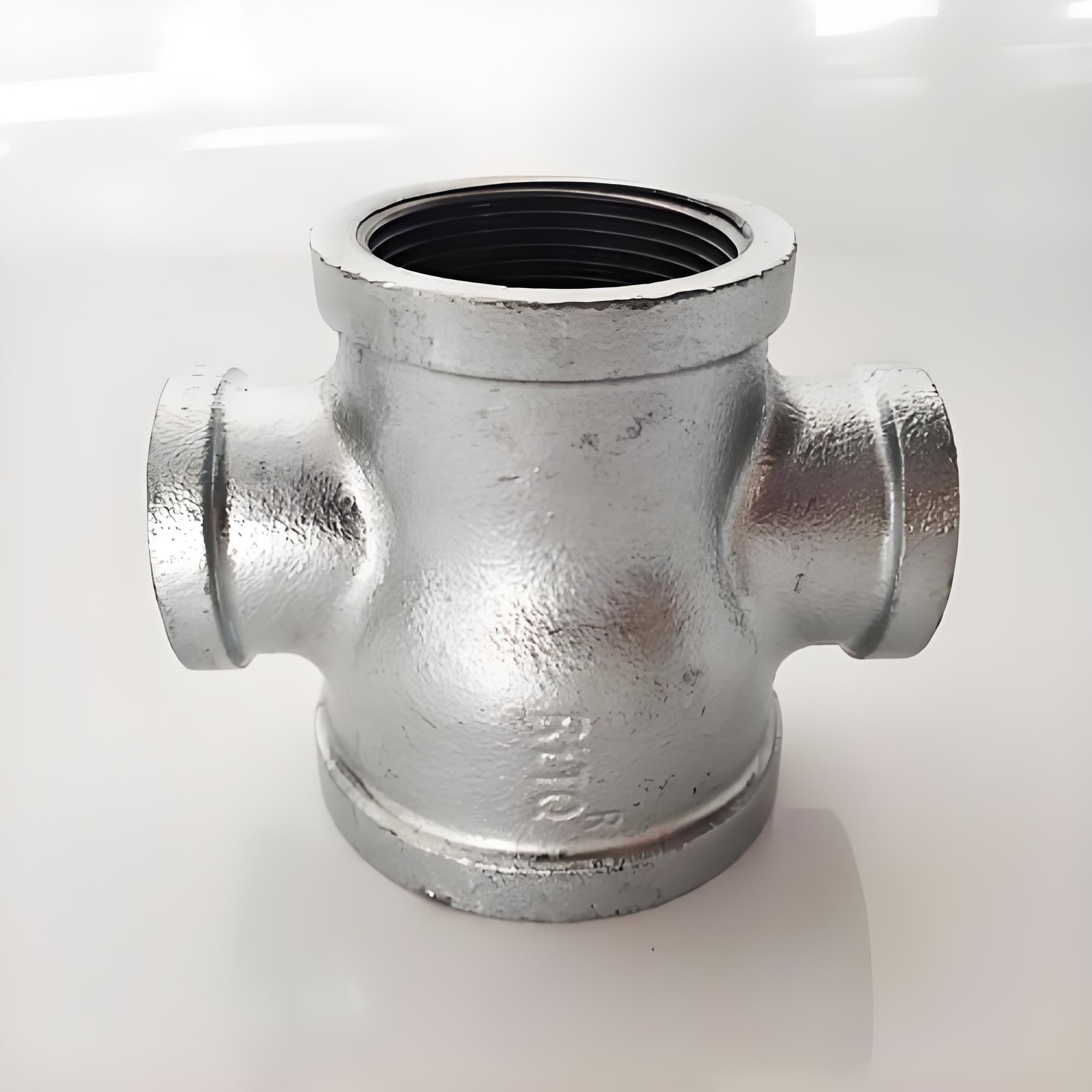
Reducing Cross
A reducing cross is a multifunctional pipe fitting that integrates flow splitting, flow merging, and reducing transition into one unit. Its four ports have different diameters, allowing main pipe flow splitting and branch pipe reducing at the same node without the need for additional reducers. It is mainly used for the intersection and connection of multiple pipelines of different specifications in industrial pipe networks, solving engineering challenges such as inconsistent pipe diameters and inconsistent branch flow rates. It can greatly simplify pipeline structures, reduce the number of fitting connections and weld leakage points, and optimize pipeline layout in confined spaces. It is widely used in oil and gas, steam, gas, chemical fluid, water supply and drainage, fire protection, and environmental water treatment systems. It can reasonably distribute pipeline pressure and flow, adapt to complex non-standard pipe network layouts, and is a core reducing and flow-splitting pipe fitting for the renovation and new construction of complex industrial pipeline systems.
Inquiry
- The biggest advantage of the reducing cross is integrated reducing forming, multi-directional diversion in one, eliminating the need for reducers, and reducing welds
- Single fitting replaces "cross + multiple reducers" combo
- greatly reducing leakage risk and construction cost. Integral hot-pressing, forging forming
- Uniform and dense pipe wall, no sand holes or air pores, high structural strength
- Excellent performance in resisting high pressure, vibration, and temperature difference deformation. Smooth streamlined inner cavity
Detailed Introduction
A reducing cross is a cross-shaped pipe fitting in which at least two of the four pipe ends have unequal nominal diameters, used to simultaneously achieve multi-branch diversion and pipe diameter transition in a piping system, without the need to additionally install reducers, thereby streamlining pipeline layout and reducing welds and leakage risks. The product complies with standards such as ASME B16.9, GB/T12459, SH/T3408, etc., with a diameter range from DN15 to DN1200, and wall thickness grades from SCH10 to SCH160 and XXS extra-thick. Forming processes include hot pushing, hydraulic bulging, forged machining, and large-plate welding, ensuring uniform and dense pipe walls, suitable for high-pressure, high-temperature, and complex fluid working conditions. Reducing crosses are widely used in petrochemical, oil and gas, power plant, coal chemical, water treatment, and other fields, especially suitable for process pipe sections in plant areas where multiple branch pipes of different specifications are simultaneously branched off. We provide various materials such as carbon steel and stainless steel, and support customization of structures such as two-way, three-way, and eccentric reducing, to meet different engineering needs.
- Integrated reducing forming, replacing the combination of a cross and multiple reducers, reducing welds and leakage points
- Supports arbitrary multi-directional reducing combinations, adapting to complex non-standard pipe network layouts
- Integrally hot-pressed or forged, with uniform and dense pipe walls and high structural strength
- Smooth streamlined inner cavity, low fluid resistance, not prone to slag accumulation or blockage
- Diameter DN15-DN1200, wall thickness SCH10-XXS, covering common industrial pipeline specifications
- Can customize eccentric structures, special materials, and surface treatments, meeting harsh working conditions
| Product Name | Reducing Cross |
| Categories | Contact Us to Confirm |
| Standard | ASME B16.9, GB/T12459, GB/T13401, SH/T3408; nominal diameter: DN15-DN1200, supports arbitrary multi-directional reducing combinations; wall thickness grades: SCH10-SCH160, XXS ultra-high-pressure extra-thick; structure types: two-way reducing, three-way reducing, eccentric reducing; connection methods: butt welding, socket welding, threaded, grooved; forming processes: hot-press forming, hydraulic bulging, integral forging, non-destructive testing; working temperature: carbon steel -20℃~425℃, stainless steel -196℃~600℃; suitable media: water, steam, oil and gas, gas, acid-base chemical corrosive fluids. All dimensions, reducing curvature, and wall thickness tolerances strictly conform to international standards, and can provide full |
| Customization | Our factory possesses full-dimensional non-standard customization capabilities for reducing cross fittings, and can customize four-way fittings with any multi-directional reducing ratio, extra-large diameter, ultra-high-pressure thickened walls, and eccentric special structures. We support customization of special streamlined inner-cavity polishing, low-resistance precision transition structures, and high-strength thickened reinforced pipe fittings, suitable for high-end clean and high-pressure severe working conditions. We can perform surface treatment processes such as sandblasting and rust removal, blackening, hot-dip galvanizing, epoxy anti-corrosion, and acid-alkali-resistant coatings. We can reverse-customize exclusive reducing cross fittings according to customers' on-site drawings, old equipment dimensions, and special pipeline parameters. We support laser marking, LOGO engraving, batch coding, and exclusive private-label packaging. We can produce high-precision material products such as low-temperature steel, duplex steel, and nickel-based alloys, adapting to the non-standard pipeline supporting needs of high-end chemical, power, and special equipment industries at home and abroad. |
| MOQ | Our factory's reducing cross fittings adopt a flexible and loose foreign trade minimum order model. The MOQ for conventional popular reducing ratio specifications is as low as 1 piece, which can fully meet the needs of sample testing, engineering supplementary parts, equipment repair and replacement, and small-order trial orders. Commonly used carbon steel and stainless steel conventional-diameter reducing cross fittings on the market support scattered purchases, mixed batches of multiple specifications, and combined shipment, with no mandatory minimum order threshold. Large-volume full-container procurement has no upper |
| Lead Time | Conventional national-standard and American-standard general-purpose reducing cross fittings are kept in regular stock. Popular reducing specifications are shipped extremely fast within 24 hours, quickly responding to customers' urgent orders, supplementary orders, and pipeline network emergency repair and modification needs. The production lead time for standard batch conventional reducing orders is 3-7 working days, with stable production capacity and punctual and efficient shipment. The lead time for ordinary non-standard reducing ratio, thickening, and fine-tuned dimension orders is 7-10 working days. Extra-large |
| Packaging | Our factory's reducing cross fittings adopt standardized multi-layer protective packaging for foreign trade export, providing full-process protection against rust, collisions, and pipe-end deformation damage. All ports are equipped with special dust-proof plugs to prevent debris from entering the pipeline and pipe-end collision deformation. The product surface is sprayed with anti-rust oil, and each piece is individually wrapped and isolated with thickened bubble film to eliminate transportation friction scratches and oxidation rust. Conventional specifications are classified and packed into reinforced export cartons. Large-diameter and large-volume orders are packed using fumigated solid wood pallets, reinforced overall with steel straps, stable and secure against loosening, suitable for long-distance ocean shipping. The outer packaging clearly marks the reducing specification, wall thickness, material, standard, batch, quantity, and export shipping marks. We support neutral packaging, customer LOGO private labeling, and exclusive shipping mark customization, fully complying with export commodity inspection, customs clearance, and overseas warehousing standardization requirements |
| Reference Price | Inquiry |
Applications
- In petroleum refining units, multiple branch pipes of different specifications diverge from the main pipe, requiring simultaneous reducing and branching
- At the intersection of power plant steam or water system pipelines, space is limited, requiring a compact reducing and branching node
- In municipal heating or water treatment pipeline network renovation, it is necessary to connect old and new pipes of different diameters
- In coal chemical or chemical process pipelines, reducing connection fittings resistant to high pressure and corrosion are required
- Foreign trade procurement buyers or engineering contractors purchase in bulk for overseas infrastructure projects.
Overview
A reducing cross is a cross-shaped pressure-bearing pipe fitting with four ports of not entirely identical diameters. It can achieve multi-way branching and pipe diameter transition at the same node, eliminating the trouble of additionally installing reducers, thereby streamlining pipeline layout and reducing welds and leakage risks. This product complies with domestic and international standards such as ASME B16.9, GB/T12459, SH/T3408, etc. Its nominal diameter range is DN15 to DN1200, and its wall thickness grades cover SCH10 to SCH160 and XXS thickened, and it can adapt to industrial piping systems of different pressure ratings.
Key Features
The core advantage of the reducing cross lies in integrated reducing forming. It combines the functions of a cross and multiple reducers into one, significantly reducing the number of pipe fittings and welding points, and lowering leakage risks and construction costs. The product adopts integral hot pressing or forging forming processes, with uniform and dense pipe walls, no sand holes or air pores, and high structural strength, capable of withstanding high pressure, vibration, and temperature differences. The inner cavity is smooth and streamlined, with low fluid resistance, natural reducing transition, and is not prone to slag accumulation or blockage, ensuring smooth medium transportation. In addition, the product supports arbitrary multi-directional reducing combinations and can customize eccentric structures to meet the needs of complex non-standard pipeline networks.
Applications
Reducing crosses are widely used in industrial piping systems such as petrochemicals, oil and gas transportation, thermal power generation, coal chemical industry, and water treatment, and are especially suitable for process pipe sections with dense pipeline intersections in plant areas and simultaneous branching of multiple different-specification branch pipes. In space-constrained machine rooms, pipe galleries, or equipment interfaces, reducing crosses can effectively save installation space and optimize pipeline layout. Whether for new construction projects or old pipeline network renovation, when pipes of different diameters need to be connected and flow splitting achieved, reducing crosses are the ideal solution.
Specifications
The product complies with standards such as ASME B16.9, GB/T12459, GB/T13401, SH/T3408, etc., with nominal diameters DN15-DN1200 and wall thickness grades SCH10-SCH160 and XXS thickened. Structural types include two-way reducing, three-way reducing, and eccentric reducing. Connection methods include butt welding, socket welding, threading, and grooving. Forming processes cover hot pushing, hydraulic bulging, forged machining, and large plate welding. Specific materials, dimensions, and tolerances can be customized according to project requirements. Welcome to contact us to confirm detailed parameters.
Purchasing & Delivery
Our factory's reducing crosses adopt standardized packaging for foreign trade export, with rust prevention and collision prevention. All ports are equipped with dust-proof plugs. Neutral packaging and customer LOGO OEM labeling are supported. The MOQ for regular specifications is as low as 1 piece, and sample testing and small trial orders are supported. Common specifications are in stock. Popular reducing specifications can be shipped within 24 hours. The delivery time for standard orders is 3-7 working days, and the delivery time for non-standard customized orders is 7-10 working days. Specific delivery times and minimum order quantities can be confirmed with us according to order conditions.
Service & Support
We provide one-stop after-sales service. All products undergo triple quality inspection before leaving the factory: appearance screening, dimension verification, and non-destructive testing. If there are quality problems or wrong specifications shipped, free replacement or return and exchange are supported. We provide free selection guidance, pipeline layout solutions, and technical Q&A, and can customize non-standard products according to customer drawings. Products enjoy long-term warranty under normal working conditions. We promise lifetime follow-up order service to ensure stable project operation.
FAQ
What are the main advantages of reducing crosses?
A reducing cross can simultaneously achieve flow splitting and size reduction, replacing the combination of a cross and multiple reducers, simplifying the pipeline structure, reducing welds and leak points, and saving installation space and cost.
What size-reduction styles are available for reducing crosses?
We offer structures such as two-way reducing, three-way reducing, and eccentric reducing, support customization with any diameter ratio, and can confirm the specific form according to your pipeline requirements.
Can reducing crosses be used in high-pressure process pipelines?
Yes. The product supports SCH160 and XXS thickened grades, is manufactured by forging or hot pressing, and has high structural strength, capable of adapting to high-pressure and high-temperature working conditions. For specific pressure ratings, please provide the working condition parameters, and we will assist in confirmation.
How should one choose between a reducing cross and an equal-diameter cross?
If the branch pipe diameters are not all the same, a reducing cross should be selected; if all port diameters are the same, an equal-diameter cross should be used. A reducing cross can reduce the use of additional reducers.
Are mixed batches and sample orders supported?
Supported. For regular specifications, the MOQ is as low as 1 piece, which can meet sample testing and small-batch needs. We also support mixed-batch combined orders of multiple specifications. You are welcome to contact us for discussion.
Submit Inquiry
Please fill in the following information, and we will contact you as soon as possible to provide product solutions or quotes based on your needs.